No products added!

About Us

We are an established digital marketing firm. Our mission is to support you in creating a loyal client base, boost sales, and grow your business.
Contact Us
Choosing the Right Dr. Pen Model
1. Which Dr. Pen model should I choose?
Choose by cartridge compatibility, power style, speed and depth range. The M8 is the classic bestseller, the M8S is its cordless USB-C update, the A11 adds a wired option and the highest top speed, the A6 runs on two swappable batteries, and the M9 adds one-click depth switching with genuine-cartridge recognition. The table below compares all five models.
Dr. Pen Model Comparison
| Model | Power / Charging | Compatible Cartridges | Main Features | Typical Use |
|---|---|---|---|---|
| M8 | Wired or wireless | A6S/M8 | Classic 6-speed control, LED display | Home and general use |
| M8S | Cordless USB-C | M8S/A8S/A11 | Digital control, anti-backflow, low-battery warning | Home use |
| A11 | Wired or wireless | M8S/A8S/A11 | Up to 15,000 RPM, wired fallback, Type-C charging, smart base | Longer or professional sessions |
| A6 | Swappable batteries | A6 | Two removable rechargeable batteries | Extended sessions |
| M9 | Rechargeable battery, Type-C fast charging; 700mAh battery | M9 compatible cartridges: 18-pin, 36-pin, 42-pin and Nano R | One-click depth switching with automatic reset, six speed levels, professional stand, genuine-cartridge recognition, up to 7,700 RPM and up to 5,300 micro-channels per second | Professional and advanced-user workflows |
2. What is the difference between the Dr. Pen M8 and M8S?
The M8S is the newer-generation update of the M8. Both offer six speeds and a 0–2.5 mm depth dial but use different cartridges and charging. The M8 (wired M8-C or wireless M8-W) charges through a cylindrical-pin port, locks with two bayonets, and takes A6S/M8 cartridges. The M8S is cordless with USB-C charging, a three-bayonet lock, anti-backflow and a digital low-battery panel, and takes M8S/A8S/A11 cartridges.
3. What is the difference between the M8-C and the M8-W?
They are wired and wireless versions of the same M8 pen. Both share the 6-speed LED display, the 0–2.5 mm depth dial, the two-bayonet lock and the same A6S/M8-compatible cartridges. The M8-C plugs in for consistent power but stays tethered; the M8-W runs on a built-in rechargeable battery, so you can move freely.
4. Does the A6 use the same cartridges as the M8?
No — they take different cartridges. The A6 uses A6-compatible cartridges with ~0.24 mm needles; the M8 uses the finer A6S/M8-compatible cartridges with ~0.18 mm needles. The bayonet mounts, housings and depth stops differ, so neither locks onto the other pen. Check the compatibility printed on the cartridge box.
5. M8S or A11 — which should I choose, and which is better for professional work?
Both share the M8S/A8S/A11 cartridges but differ in power style and top speed. The M8S is cordless with USB-C charging and digital control. The A11 runs wireless or wired through its cable and reaches up to 15,000 RPM — the choice for top speed plus a wired fallback in longer or professional sessions; the M8S covers everyday cordless home use.
6. How do the Dr. Pen models compare, and what do the model names mean?
Model letters are not a fixed naming system and do not rank the models by number. Choose by compatible cartridges, charging style, speed and depth range rather than the code.
7. Wired, wireless or swappable batteries — which power style should I choose?
Wired models like the M8-C give consistent power but stay tethered to an outlet. Wireless models (M8-W, M8S, A11) run on built-in batteries, so you move freely and recharge between sessions. The A6 takes two removable batteries that swap mid-session for extended runtime away from outlets.
8. How do I choose a pen for home use versus professional use?
For home use, pick a cordless model such as the M8-W or M8S and keep sessions shallow (0.25–0.5 mm) or use nano tips. For professional use, choose a model covering the full depth range, with a wired option for long sessions (the A11’s cable or wired M8-C), that takes the cartridges your practice uses.
Finding the Right Cartridges for Your Dr. Pen
1. Which cartridges fit which Dr. Pen model — and can I use cartridges meant for other models or from other brands?
Cartridges do not cross-fit between models. The A6 takes A6-compatible cartridges; the M8 (M8-C and M8-W) takes A6S/M8-compatible cartridges (11/16/24/36/42-pin); the M8S, A8S and A11 take M8S/A8S/A11-compatible cartridges (12/18/24/36/42-pin, nano included). Mounts, housings and depth stops differ, and unbranded “universal” tips may lock poorly or sit at the wrong depth. The cartridge box states which models it fits; genuine Dr. Pen cartridges are available in the shop.
2. What do the pin counts (11–42) and the depth numbers (0.25–2.5 mm) on cartridges and dials mean?
Pin count is the number of needles: higher counts give denser coverage on broad, flat areas; lower counts suit small or curved zones. Depth is how far needles extend: the cartridge sets the maximum, and the dial runs at or below it. Pin count and depth are chosen separately — deeper is not better.
3. Which cartridge depth and pin count should I start with for my skin goals?
For product infusion with no needle feel, use nano tips (repeatable weekly). For first-time fine-line work, run a shallow needle cartridge at 0.25–0.5 mm about every two weeks; deeper 1.0 mm+ work is spaced four to six weeks and typically done professionally. Among needles, 24-pin is a common all-rounder.
4. Nano tips vs regular needle cartridges — which should I use?
Needle cartridges pierce the skin to create micro-channels; nano tips do not pierce, working serums into the upper layers with little to no downtime. Nano tips fit the M8S, A8S and A11.
5. Are Dr. Pen cartridges sterile and individually sealed?
Yes — genuine cartridges are single-use sterile items in sealed packaging that stays sterile until opened. Open a cartridge only when ready to mount it, hold it by the housing, and never touch the needle window. If the packaging arrived open or damaged, do not use the cartridge — contact customer support with your order number.
6. Can I use an M8 cartridge in an M8S?
No — the M8 and M8S take different cartridges. The M8 uses A6S/M8-compatible cartridges (11/16/24/36/42-pin); the M8S uses M8S/A8S/A11-compatible cartridges (12/18/24/36/42-pin, nano included). The bayonet mounts, housings and depth stops differ, so an M8 cartridge will not lock onto an M8S — never force it. Order M8S/A8S/A11-compatible cartridges and check the box.
7. Which cartridge should I use on small or curved areas?
Use a lower-pin-count cartridge on the nose, lips, jawline and similar curves — fewer needles make a smaller head that follows the contour. With A6S/M8 cartridges that means 11 or 16 pins; with M8S/A8S/A11 cartridges, 12 or 18 pins. Keep the depth shallow and pass lightly.
8. How should unused cartridges be stored?
Store unused cartridges in their original sealed packaging in a cool, dry place away from direct sunlight, moisture and dust. Open packaging only when ready to mount. Discard any cartridge with a broken seal or damaged housing, and never store used cartridges — they are single-use.
Using Your Dr. Pen: Setup, Technique & Frequency
1. How do I set up my Dr. Pen for the first time?
Charge, clean, mount a fresh correct-type cartridge, then test at the lowest speed and shallowest depth before touching skin. Button order, charging indicators and cleaning steps are model-specific — follow the included manual. A pen that will not turn on usually has an uncharged battery or a cartridge that is not seated properly.
2. How do I attach and remove a cartridge correctly?
Mounting uses a bayonet lock that differs by model — two-bayonet on the M8, a firmer three-bayonet on the M8S/A8S/A11. Align the cartridge slots with the handpiece lugs, push gently, and twist until seated; never force it or run the pen half-seated. To remove, twist the opposite way and lift straight off without touching the needle array.
3. How do I set the depth dial and speed on my Dr. Pen?
Set depth and speed before each session: start at the shallowest depth and lowest speed, and increase only as your skin tolerates. Never exceed the cartridge’s own depth rating, and allow the recovery window for the depth used. Exact controls are model-specific — follow the included manual.
4. How should I move the pen, and how long should a session last?
Work in slow, even passes with light, consistent pressure, stretching the skin and covering the area in overlapping vertical, horizontal and diagonal lines; keep the pen moving so no spot is over-treated. End when the target zone is evenly covered. Stop on sharp pain, more than pinpoint bleeding, or skin that looks abraded.
5. How often can I microneedle, and how long does the skin take to recover?
Frequency depends on depth: nano tips, about a week between sessions; 0.25–0.5 mm, about every two weeks; 1.0 mm and deeper, four to six weeks. Redness at shallow depth usually settles within hours to a day or two; deeper responses last weeks. Delay the next session if the skin still feels sensitive, looks flushed or shows crusting.
6. What should I put on my skin before and during a session?
Cleanse and disinfect both the skin and the device before any needling. During the pass, use a glide medium such as a hyaluronic acid serum — never work on dry skin. Pause strong actives like retinoids and acids around session days, as needling raises their penetration and irritation potential.
7. Can I use a Dr. Pen on the scalp?
Yes — start clean, mount a fresh cartridge of the correct type, keep the depth shallow, and stop on sharp pain. Part the hair section by section so the cartridge reaches the skin; use a lower pin count for small sections and keep the pen moving with light pressure. For hair loss or a scalp condition, consult a qualified professional.
8. Can I use a Dr. Pen on the body?
Yes — clean the area, mount a fresh cartridge of the correct type, and stop on sharp pain. Use higher pin counts on broad, flat areas and lower counts at a shallower depth on smaller or curved zones; start shallow on any new area. Never needle over moles, warts, varicose veins, broken skin, raised lesions, or near the eyes.
9. My Dr. Pen stopped mid-session or will not start — what do I check?
Check the charge first — low battery is the most common cause (a drained M8S needs about two hours on USB-C). Then reseat the cartridge or fit the correct type; a half-seated or wrong cartridge can stop the pen. The A11’s smart-base auto power-off is a feature, not a fault. If it still will not run, follow the manual’s troubleshooting or contact customer support.
Dr. Pen Safety, Hygiene & Aftercare
1. Is at-home microneedling with a Dr. Pen safe — and who should not use one?
Used as directed — the right device, shallow depths, strict hygiene — yes, but it is not risk-free. Keep unsupervised home sessions shallow (0.25–0.5 mm) or use nano tips; deeper work belongs in professional settings. Avoid needling, or get medical advice first, if you have active acne, infection, rash, eczema or psoriasis in the area, a history of keloid or poor scarring, a bleeding disorder or blood-thinning medication, impaired healing (recent isotretinoin or radiation), or if you are pregnant. When in doubt, ask a qualified professional.
2. Can I use a Dr. Pen after sun exposure or a peel?
Not until the skin has fully recovered. Needling sunburned, peeling or recently peeled skin adds trauma to an already stressed barrier — wait until any redness, peeling, flaking or irritation has cleared. After a professional peel, follow that procedure’s advised recovery window first.
3. What should I do right after a session (aftercare)?
Clean the treated skin gently, apply a soothing, hydrating product, and keep the area protected. Skip makeup for the first hours to a day, pause acids and retinoids until the barrier recovers, and use strict sun protection. Redness and mild warmth are normal and fade within hours to a day or two; deeper sessions recover longer.
4. Can I exercise or swim after a session?
Give the skin its first recovery window: for at least a day after a shallow session, avoid heavy exercise that causes heavy sweating, plus pools, saunas, steam rooms and hot baths. Extend the wait if the area still looks red or feels sensitive. When you resume, shower gently, pat dry, and reapply a soothing product.
5. How do I clean and disinfect my Dr. Pen between uses?
Clean the device before and after every session. With the pen off and the cartridge removed, wipe the handpiece and mounting area with isopropyl alcohol on a cloth and let it dry — never submerge the motor or charge it wet. Cartridges are single-use and never cleaned for reuse. Store the device dry and follow the manual’s cleaning steps.
6. Are cartridges single-use? Can I share a device or tips? How should I handle and dispose of them?
Treat every cartridge as single-use and single-person: a used cartridge has touched skin that needling just broke, its needles dull, and it cannot be kept sterile between sessions, so reuse is the main avoidable hygiene risk. Dispose of used cartridges in their own packaging or a puncture-resistant container so the needles cannot prick anyone. The handpiece is personal too — if shared, each person needs a fresh cartridge and the handpiece must be disinfected between users; professional sharps rules apply if you treat others.
7. What side effects are normal — and what warning signs mean stop?
At shallow depths, expect redness, mild swelling and warmth lasting from hours to about a day; deeper sessions add pinpoint bleeding and a longer recovery. Stop and consult a qualified professional on spreading redness or pain after the first day, weeping or crusting beyond the pinpoints, fever-like symptoms, or unusual scarring or pigmentation changes.
8. What is the anti-backflow design, and why does it matter?
Anti-backflow is a one-way barrier in newer models such as the M8S and A11. During needling, serum, blood or lymph can collect at the cartridge mouth; the membrane stops that fluid being drawn back into the handpiece toward the motor. Its purpose is hygiene — it keeps the device from becoming a contamination reservoir between cartridge changes.
Orders, Shipping & Returns
1. What should I do if I receive the wrong model or cartridge?
Do not use the item. Keep the original packaging and shipping label, take clear photos of the product and package, and contact customer support with your order number. The request will be reviewed based on the order details and the specific situation; support will confirm the next steps.
2. How long does shipping take — is it free, and how do I track my order?
Shipping is free worldwide. Orders are processed and dispatched within 1–3 business days after payment, and standard delivery takes 7–15 business days after dispatch (Shipping Policy). You receive a tracking link after dispatch. Remote areas, customs, holidays, weather and carrier issues can extend delivery — check the tracking link first, then contact customer support if the parcel stays stuck well beyond the estimate.
3. What is your return and refund policy?
Every return or refund request is reviewed case by case based on order status, product condition and the request details. Contact customer support first with your order number — do not send anything back before receiving instructions. If accepted, support confirms the return method, any fees, the refund method and next steps (Return & Refund Policy). Generally, contact support within 30 days of receiving the item, unused and in original condition and packaging; approved refunds take extra time through the payment provider.
4. How do I cancel an order, change the shipping address, or report a damaged delivery?
Contact customer support with your order number — every request is reviewed against the order’s status. Cancellations and address changes are easiest before dispatch; once shipped, the address can usually no longer be changed. For a damaged delivery, keep the original packaging and shipping label, photograph the damage, and send the photos with your order number to customer support, which files a carrier claim on your behalf. Do not discard the box or label until the case is closed.
5. What should I do if my order is missing an item or the package arrives open?
Do not use the item. Keep the original packaging and labels, take clear photos, and contact customer support with your order number. Every case is handled on its own — no replacement or refund is promised, and support decides based on the specific situation.
Dr. Pen Authenticity & Verification
1.How to verify a Dr. Pen device or cartridge
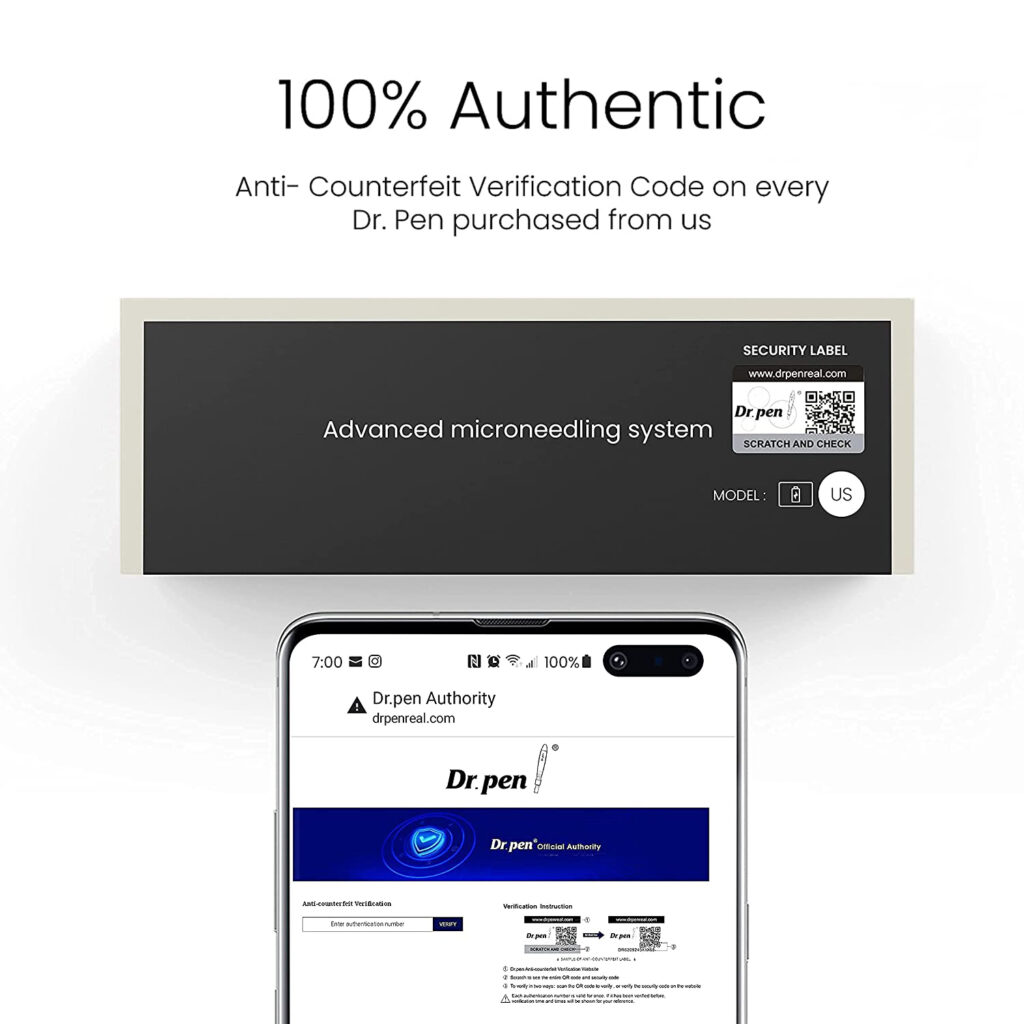
A genuine new Dr. Pen product should arrive in sealed retail packaging with a holographic security seal and a scratch-off verification code.
- Check that the retail packaging and holographic seal are intact.
- Scratch the seal open fully so the QR code and authentication number are visible.
- Enter the authentication number or scan the QR code at drpenreal.com.
- Complete the verification before using the device or cartridge.
Each code is intended for first-time verification. If a code appears as “already verified twice,” enter the code manually at drpenreal.com before drawing a conclusion.
Hydra Pen and Bio Pen products use their own verification websites rather than the Dr. Pen verification process.
2.How to check the model you received
Compare the model name on the retail box, device label and order confirmation.
Check the cartridge type against the model compatibility shown on the packaging. Do not force a cartridge into a device if the model information does not match.
3.What to do if verification fails
Do not use a product if the security seal is damaged, the packaging is open, the model information does not match, or a fresh code cannot be verified.
Contact customer support with:
- Your order number
- Clear photos of the packaging and security seal
- The model name and device label
- A screenshot or description of the verification result
Please wait for support instructions before using the product or sending anything back.
4.Where to purchase
Dr. Pen devices and cartridges are available from the Dr. Pen Online Store. The store’s Official Retailer page provides the authorization information.
5.Verification reminder
A verification code is one part of an authenticity check. Also compare the packaging, model label, order details and product appearance. Keep your order confirmation and packaging until the product has been checked.
This page provides product verification information only. It is not medical, legal or regulatory advice. Product specifications and verification instructions may change; confirm the current details on the relevant product pages.